10 Security Measures for Charlotte Small Businesses – Cybersecurity, Physical Protection, and Staff Training
For a small business, a security breach – whether cyber-related or physical – can cause immediate and devastating consequences. Severe financial losses, damage to the business’s reputation, harm to employees, legal fees, operational downtime, and even shutdowns are tragic yet common effects of system or building intrusions.
In 2025, Charlotte was ranked among the top 10 safest major cities in the country. Yet even the safest cities aren’t exempt from taking business security seriously. While some neighborhoods may offer more peace of mind than others, every business should thoughtfully consider the responsibility of protecting their physical and non-physical assets. And when it comes to cyber threats, no business is immune.
While some security features may be more important in certain businesses compared to others, having appropriate and layered security measures is the best way to mitigate crisis management and stop security breaches or break-ins before they cause any damage.

KEY TAKEAWAYS / TL;DR
• The most effective security strategy for small businesses combines cybersecurity, physical protection measures, and regular employee training in a layered approach.
• Businesses are 67% more likely to experience a cyber attack than a physical theft, making digital security measures equally critical as physical security systems.
• Shared and flexible workspaces present unique security vulnerabilities due to centrally managed Wi-Fi, open access, diverse users, and high visitor traffic.
• Human error contributes to up to 95% of data breaches. One phishing email or malware attack is capable of causing extensive damage to business operations.
• Environmental alerts for smoke, extreme temperatures, water, or gas can be as catastrophic as burglary, making combined alarm systems essential for comprehensive protection.
The Importance of Security in Shared and Flex Workspaces
More Charlotte small businesses are turning to flexible spaces, taking advantage of reduced overhead, better collaboration, shorter lease options, and greater potential for hybrid work models. And while the benefits of flex space are numerous, these types of buildings also come with unique challenges and vulnerabilities. For small business owners, taking a proactive approach to robust security measures is crucial.
While flex spaces encourage collaboration and provide adaptability and convenience for many types of businesses, these shared environments can also lead to a greater potential for safety concerns due to the nature of sharing space: centrally managed Wi-Fi, open and fluid access, shared desks and open floor plans, diverse users, ambiguity around roles and responsibilities, and high visitor traffic.
For Charlotte businesses, implementing a layered security approach is the best way to ensure that operations remain safe, data stays protected, and employees feel confident in their workspace.
Main Types of Security for Small Businesses
There are three main categories of security that most security measures fall into. They are:
- Cybersecurity. In today’s world, digital concerns are becoming increasingly common, and don’t necessarily have much to do with physical location. Even in the safest neighborhoods, the potential threats of data breaches and cyber attacks are very real. One study found that businesses are 67% more likely to have experienced a cyber attack compared to a physical theft. An effective security posture requires maintaining strong cybersecurity to protect direct theft and sensitive information, reducing the chance of downtime, response costs, and other major issues.
- Physical protection and monitoring. Physical security best practices include tools such as security cameras and surveillance, alarm systems, intercoms, fireproof safes, and more.
- Employee training. One of the best ways to protect business assets – both physical and digital – is proper employee training. Regular and required training for employees creates awareness, helps staff to recognize scams and potential cyber threats, ensures that security measures are in place (such as multi-factor authentication and strong passwords), and creates confidence by preparing team members for any potential physical threats.
Security Category Risk Comparison
| Security Type | Primary Threat | Average Impact Cost |
| Cybersecurity | Data breaches, ransomware | $200,000+ per incident |
| Physical Protection | Break-ins, theft | $8,000-$35,000 per incident |
| Employee Training | Human error (up to 95% of breaches) | Prevention reduces risk by 70% |
Top 10 Security Measures for Charlotte Small Businesses
The best security strategy is a multi-faceted one, combining cybersecurity, physical safety measures, and regular training for employees. Here are the top 10 security measures to consider adding to your business operations.
1. Cybersecurity Measures
It’s easy for small businesses to overlook cybersecurity, but anyone can be a victim of cyber threats. And unfortunately, digital threats can be as damaging as physical break-ins.
As a major financial hub, Charlotte can be a top candidate for cyber crime. And while fields such as healthcare, law, finance, and retail tend to be prime targets, anyone can be a victim of a cyber attack.
For small businesses, top cybersecurity measures include:
- Multi-factor authentication (MFA)
- Strong password policies
- Regular data backups
- Firewalls and secure networks
- Regular software updates
- Use of a VPN on public or shared Wi‑Fi
- Role-based access controls
- Phishing and security awareness training for employees
- Secure, encrypted cloud storage for business files
- Regular vulnerability scans or basic security assessments
In some cases, hiring out cybersecurity services can be a worthwhile investment.
Essential Cybersecurity Implementations by Priority
| Priority Level | Security Measure | Implementation Difficulty |
| Critical | Multi-factor authentication + Strong passwords | Low |
| High | Regular backups + Firewall protection | Medium |
| High | Employee phishing training | Medium |
| Medium | VPN for shared Wi-Fi + Encrypted cloud storage | Medium |
| Medium | Quarterly vulnerability scans | High |
2. Security Cameras and Video Surveillance
Modern security cameras and video systems offer proactive monitoring as a way to deter crime as well as to provide valuable video evidence should a break in happen. Consider installing cloud-connected, high-definition cameras near access points such as entryways, parking areas, and in common spaces. Many systems also allow the option for remote monitoring, which allows business owners to keep an eye on the location in real time.
3. Motion-Activated Lighting
Smart lighting and motion-activated systems not only save on energy costs but also deter potential threats around the building. In addition to startling possible intruders, bright lights increase visibility around entry points such as doors, walkways, and parking lots.
In flex spaces, where occupancy varies day-to-day, motion-activated lighting can be especially helpful in terms of both security and energy costs.
4. Alarm Systems
A responsive alarm system is a strong defense against unauthorized access. Choosing a combined system that monitors for intrusion and environmental alerts (such as smoke, extreme temperatures, water, or gas) is often the best bet for a small business, since environmental events can be just as catastrophic as a burglary.
Be sure to cover all realistic entry points (such as exterior doors and accessible windows) while avoiding aiming motion sensors at legitimate traffic zones that could trigger a false alarm. Consider integrating alarms with cameras in order to quickly verify a real break-in versus a false trigger. Be sure to test and maintain systems regularly.
5. Intercom and Tele-Entry Systems
In shared buildings and hybrid work spaces, access management is key. Intercom systems and tele-entry makes it easier to screen visitors before granting access, thus reducing the chance of unwanted guests. Modern intercom systems can provide anything from audio only to video verification and even remote control to grant access from a phone or tablet.
Depending on the nature of the business and building type, hardwired or cloud-based systems may provide the best security options.
6. Secure Cash Handling and Fireproof Safes
For any business that handles cash, secure storage is a must. Fireproof, bolt-down safes provide security, especially when combined with strict deposit procedures. Minimizing cash on-site, ensuring limited access, and installing monitoring systems near safes and cash handling areas also reduces theft risk both internally and externally.
7. Access Control and Smart Locks
Access control systems eliminate traditional keys and can provide more control over who enters a space and when. Key cards and smart locks can also enable remote access management, which is ideal for landlords or business owners who share a flex building. An effective access control system at all points of entry can greatly lower the risk of unauthorized access to a building.
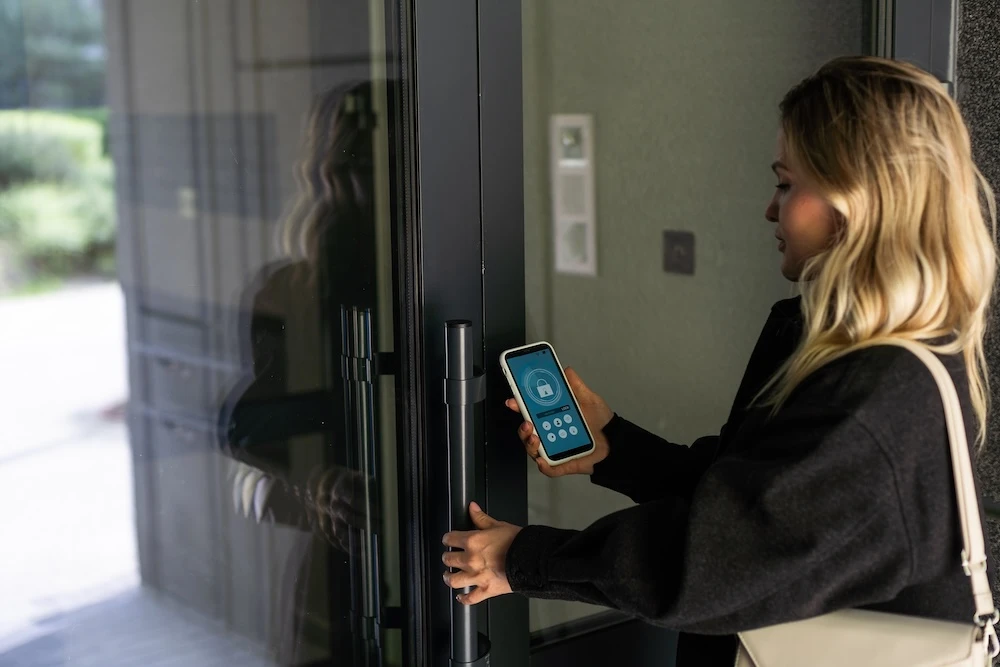
Access Control System Comparison for Flex Spaces
| System Type | Best Use Case | Key Advantage |
| Key Card/Fob | Multi-tenant buildings | Easy to deactivate lost cards |
| Smart Lock (PIN) | Individual offices | No physical key management |
| Mobile App Access | Hybrid work environments | Remote access management |
| Biometric | High-security areas | Cannot be shared or stolen |
8. On-Site Security Officers and Mobile Patrol
Armed security guards and K-9 patrols are often considered only for large corporations such as financial institutions, but entertaining the option of professional services can be a plausible option for smaller companies too, especially when the cost can be shared by multiple tenants. A physical security presence, including security guards and/or mobile patrol units, can deter loitering and offer a quick response to suspicious activities.
Even if only part time, the sight of security units patrolling high-traffic areas can discourage security breaches proactively.
9. Employee Training and Awareness
One of the leading causes of security breaches is human error. In fact, one study found that in 2024, 95% of data breaches were tied to human error. Fortunately and unfortunately, in many cases, only one or a few staff members tend to contribute to the majority of security breaches. In other words, one phishing email, data leak, or malware attack can lead to a whole host of problems.
Because of this, it’s vital to provide all employees with extensive training so that they can spot suspicious activity, phishing emails (a common tactic to trick employees into revealing sensitive data), outdated software, and other social engineering scams.
10. Regular Security Assessments
Just because nothing has happened doesn’t mean that it won’t. Regular security assessments are important for making sure that all systems are functioning as they should and that all of your main bases are covered.
It’s a good idea to conduct quarterly assessments to test alarms, locks, network security settings, safe keypad batteries, and other systems. In addition, regular training for employees ensures that everyone is up-to-date on procedures and prepared to spot potential security breaches.
For some businesses, it may be worth partnering with a professional security consultant to ensure that you have the proper measures in place for potential threats.
Quarterly Security Assessment Checklist
| Assessment Area | What to Check | Frequency |
| Physical Systems | Alarms, locks, cameras, lighting | Every 3 months |
| Cyber Security | Software updates, password strength, MFA | Every 3 months |
| Employee Training | Phishing tests, procedure reviews | Every 6 months |
| Access Controls | User permissions, expired credentials | Every 3 months |
| Professional Audit | Comprehensive vulnerability assessment | Annually |
What Are Charlotte’s Safest Neighborhoods?
The Charlotte-Mecklenburg police department is working hard to reduce crime and theft in Mecklenburg County and the surrounding neighborhoods, and that work is paying off. At the end of 2025, the CMPD released an update stating that in 2025, overall crime decreased by 9%, violent crime decreased by 21%, and property crime decreased by 6%. All the while, Charlotte, North Carolina is still one of the fastest growing cities in the U.S.
Around Charlotte, some of the safest neighborhoods include SouthPark, Ballantyne, Dilworth, and Myers Park. Concord and the Lake Norman area cities of Huntersville, Davidson, and Cornelius are also recognized as being remarkably safe, and offer a plethora of options for flex buildings.
FAQs About Security Measures for Charlotte Small Businesses
What’s the most common security threat for businesses?
The most common security threat for businesses is cyber attacks. Businesses are 67% more likely to experience a cyber attack than a physical theft. Phishing, malware, ransomware, and business email compromise (BEC) are the primary cyber threats, with human error contributing to 60%-95% of data breaches.
One phishing email or malware attack can cause extensive damage to business operations, making cybersecurity measures equally as critical as physical security systems for protecting small businesses.
Is Charlotte, NC safe for businesses?
Charlotte, NC presents typical urban security challenges that require small businesses to implement comprehensive protection measures. Businesses in Charlotte should focus on a layered security approach combining cybersecurity, physical protection measures like alarm systems and surveillance cameras, and regular employee training.
Shared and flexible workspaces in Charlotte present unique security vulnerabilities due to centrally managed Wi-Fi, open access, diverse users, and high visitor traffic, making it essential for businesses to take proactive security steps regardless of location.
How much does cybersecurity cost for a small business?
The cost of hiring out cybersecurity for a small business can range from $50-$200 per month. Since the impact of a cybersecurity incident can cost $200,000 or much more, and businesses are more likely to experience a cybersecurity threat than a physical threat, many businesses consider cybersecurity a worthwhile investment.
There are many cybersecurity precautions that are free or nearly free to implement, however, including multi-factor authentication, strong passwords, regular backups, firewall protection, and regular employee training.
Can small businesses in flex spaces negotiate security responsibilities with landlords?
Yes. Before signing a lease, clarify in writing which security measures are the landlord’s responsibility versus the tenant’s. Typically, landlords manage building-wide systems like exterior cameras, parking lot lighting, and common area access controls, while tenants handle internal office security.
Request information about the building’s existing security infrastructure and ask if costs for enhanced measures can be shared among multiple tenants. Some flex space landlords may be willing to upgrade security systems if tenants commit to longer lease terms.
What security grants or tax incentives are available for Charlotte small businesses?
Small businesses may qualify for federal tax deductions under Section 179 of the tax code, which allows immediate expensing of alarm systems and security systems for non-residential properties.
Some insurance companies also offer security equipment rebates or premium reductions for businesses that implement specific measures. Additionally, the Small Business Administration occasionally offers disaster preparedness loans that can include security improvements.
The City of Charlotte also offers a security grant of up to $5,000 to fund physical security updates as recommended by the Charlotte-Mecklenburg Police Department.
Get Personalized Advice When Choosing Your Next Flex Building
Small businesses thrive when employees, owners, and property managers are all on board with proper security measures. By combining cybersecurity, physical protection, and team member training, you can build a secure workspace that protects your assets, builds trust with clients and partners, and minimizes potential security incidents.
But a thriving business is about so much more than just security. You need lease terms that fit your needs, the right building near your target customers, and a labor pool that provides you with upstanding team members. At Regent Commercial Real Estate, we take a holistic approach to helping our clients find their ideal commercial property.
Our process starts and ends with you: from getting to know your specific needs to providing expert negotiation to making sure you experience a successful move in.
If you’re ready to take the first step toward finding your next Charlotte flex property, we’re here to help. Request your free customized market report or contact us to start the conversation.
Share This Story, Choose Your Platform!
About the Author: Brian Smith, SIOR | CCIM | MBA

Related Posts



What our clients are saying


Unlock Exclusive Commercial
Property Listings